THE HOUSE & THE DURFEES
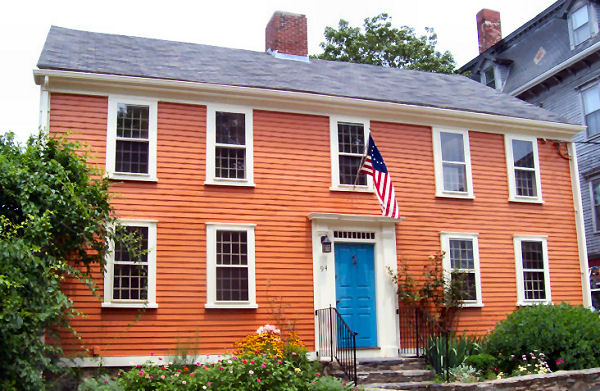
In 1775, in what is now Fall River (then part of Freetown), there were eighteen houses, most clustered near the Taunton River.
Part way up the hill to the north stood Judge (and Legislator) Thomas Durfee's house, a large home for those times. The house was situated just south of the present Superior Courthouse on North Main Street. An interesting fact is that the well for the house still is visible behind the Courthouse. The house was probably built before Durfee’s son, Joseph, was born in 1750. The Judge was then about thirty years old.
The Durfee property extended from the Taunton River eastward to the Watuppa Pond; a vast acreage of fields, orchards, outbuildings and woodlands with deer roaming freely. In later years Judge Durfee would mortgage all his lands to help finance the American Revolution, a goal toward which he was completely devoted. His son, Joseph, was destined to lead a company of Minutemen in the heroic struggle for independence. As a colonel, Joseph Durfee, served with Lafayette in battles at White Plains, New York and across the State of Rhode Island.
THE HOUSE & THE WAR
 At twenty-eight years of age in early 1778, Colonel Joseph Durfee, with his band of Minutemen, successfully defended Fall River from a British attack.
That same summer the Durfees were hosts to another young soldier fighting for the cause of American liberty, the tall and red haired twenty year old, Marquis de Lafayette, with whom Joseph Durfee had previously served.
Another feature of this relationship was that the young bride of Lafayette's aide, Robich Foucauld, was a D'Urfe.
The Durfee home was a way station between Newport and Boston. History tells us that Lafayette made several visits. The Marquis was given the second floor bedroom in the southwest corner of the house (as it now stands).
We can picture the Marquis and the Durfees discussing events and strategy in the parlor. Perhaps Lafayette', aides relaxed in the yard, muskets handy, while from the kitchen came the aroma of food being prepared for the guests.
THE HOUSE & ITS HISTORY
 There were three long-term owners of the Lafayette-Durfee House: the Durfees, the Anthonys and the Lewins.
The house served the family of Thomas Durfee and subsequent Durfee generations until 1836.
In 1847 the Reverend John Anthony took up residence in the house when one of his sons, David, was twelve years old. Fall River was a busy town then. Young David worked in the mills and attended a mill school. In later life he formed the partnership of Anthony, Swift & Co. with his brother Charles and Gustavus F. Swift. In 1873 David Anthony decided to replace the post and beam house with a brick mansion and sold the 1750 house to Charles Y. Lewin.
Charles Y. Lewin had the house moved to the present site in what once was the Durfees' apple orchard. Moving the house down Cherry Street hill, without the benefit of power equipment, must have been a challenge. We can imagine manpower, oxen and much ingenuity. The house remained in the Lewin family until the death Emily C. Lewin, a retired Fall River schoolteacher, in 1936.
In 1973, Caroline Durfee, a descendant of Thomas Durfee, formed a group interested in preserving the historic house. Restoration was done by Vaughn Baash of Westport. Fireplaces were restored and in the attic and cellar were found hand hewn beams with wooden pegs.
School children and adults, in response to fund-raising, wrote their names on the inside of the clapboards. In 1976 mementoes of the nation's bicentennial celebration were sealed in a time capsule in the base of the fireplaces in the cellar.
The planning and efforts of many persons enable us to see and appreciate the 1750 farmhouse. When the American and French flags are flown side by side over the front door we share an experience in local history.